
Intermediary Corporations and Subsection 74.4(2): The CRA’s Position on Indirect Loans and Deemed Interest

An analysis of a CRA interpretation (2025-1085691E5 ) on indirect transfers, intermediary corporations and the deemed-interest inclusion
Consider a common planning structure. An individual contributes funds to a wholly owned holding company, which then lends the funds to, or subscribes for preferred shares of, a corporation owned by the individual’s spouse. The spouse’s corporation pays a return to the holding company, and the holding company passes that return on to the individual.
That assumption warrants scrutiny. A CRA interpretation addresses precisely this arrangement, and the conclusion is more nuanced than either “the holding company breaks the chain” or “the structure never works.” This article summarizes the CRA’s position, its significance and the factors that bear on the outcome.
The short answer
Subsection 74.4(2) of the Income Tax Act can look through an intermediary corporation. When money genuinely flows from an individual through a holding company to a spouse’s corporation, and a matching return flows back, the amount paid to the individual may reduce the deemed-interest inclusion that subsection 74.4(2) would otherwise create.
The operative word is “may.” There is no automatic dollar-for-dollar offset, and using a holding company does not exempt an arrangement from the rule. The outcome depends on the facts.
Overview of subsection 74.4(2)
Subsection 74.4(2) is an anti-income-splitting rule. It targets arrangements in which an individual transfers or lends property, directly or indirectly, to a corporation and the arrangement is intended, in whole or in part, to reduce the individual’s income while benefiting a designated person. A designated person is commonly a spouse or common-law partner, although the statutory definition and the modified specified-shareholder test must be applied to the particular facts.
In general, the rule requires that:
the transfer or loan is made by an individual who is resident in Canada;
property is transferred or lent to a corporation, either directly or indirectly;
one of the main purposes of the transfer or loan may reasonably be considered to be the reduction of the individual’s income and the benefit of a designated person;
the designated person satisfies the specified-shareholder test applicable for subsection 74.4(2); and
the relevant corporation is not a small business corporation for purposes of the provision.
When the rule applies, the individual is deemed to have received interest calculated by reference to the prescribed rate and the amount of the outstanding transfer or loan. That deemed amount is generally reduced by qualifying amounts the individual actually receives, including interest received on the transfer or loan and, in the right circumstances, taxable dividends received on shares issued as consideration for the transfer.
The rule prevents an individual from shifting investment capital into a corporate structure that benefits a spouse or other designated person while leaving the individual with little or no taxable investment income.
Scenario one: the interest-bearing loan
In the first example, Company A lends Mr. A’s funds to Opco B at an agreed interest rate. Opco B pays interest to Company A, and Company A pays a corresponding amount of interest to Mr. A.
The CRA indicated that it would generally be prepared to treat the payment from Company A to Mr. A as an amount received in respect of the indirect loan, provided it is reasonable to conclude that the payment was indirectly funded by, or arose from, Opco B’s interest payment.
Illustrative example
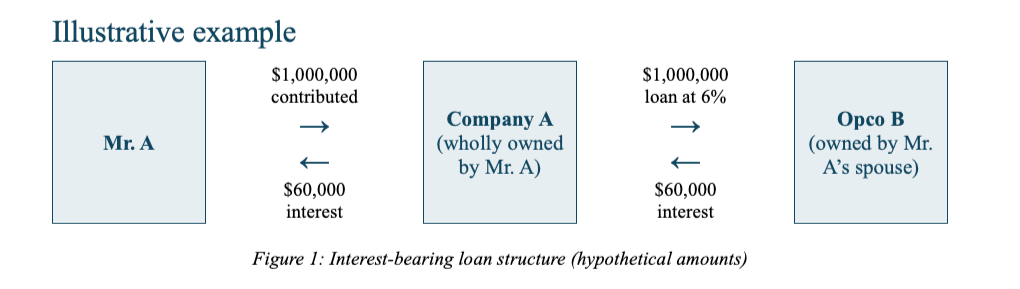
Using the amounts illustrated above, if the deemed interest under subsection 74.4(2) were $80,000 for the period, the $60,000 of actual interest paid to Mr. A could potentially reduce the deemed inclusion to $20,000.
Substance over form
The result does not rest solely on the legal form of the payments. The payment to Mr. A must be reasonably connected to the indirect transfer or loan. Factors that support that connection include:
matching or substantially matching interest rates;
corresponding principal amounts;
similar payment timing;
direct tracing of the funds; and
documentation showing that Company A is passing through the return generated by Opco B.
A mismatch in amounts, timing or rates would not necessarily eliminate the reduction entirely, but it could limit the amount that can reasonably be attributed to the indirect loan. Conversely, if Company A receives interest from Opco B but retains it, uses it for unrelated purposes, or pays Mr. A an unrelated amount, it may be more difficult to establish the required connection.
Scenario two: preferred shares and dividends
The same general reasoning applies where Company A subscribes for preferred shares of Opco B instead of making a loan, as illustrated below.

The CRA indicated that a dividend Company A pays to Mr. A may be taken into account to reduce the subsection 74.4(2) deemed-interest amount if the dividend can reasonably be regarded as arising indirectly from Opco B’s dividend payment.
This does not mean that every dividend paid by an intermediary corporation automatically offsets deemed interest. The relevant question is whether there is a sufficient economic and factual connection among the following:
· the property transferred or lent by Mr. A;
· the preferred-share investment made by Company A;
· the dividend received by Company A from Opco B; and
· the dividend subsequently paid by Company A to Mr. A.
A dividend paid from unrelated corporate funds, accumulated earnings or another investment may not qualify merely because it was paid during the same period. Likewise, Company A's legal capacity to declare a dividend is not enough to show that the dividend arose from Opco B’s payment.
The characterization of the payment is also relevant. A dividend can have different tax consequences from interest, including different treatment for integration and corporate-tax purposes. Nevertheless, for purposes of the subsection 74.4(2) calculation, the CRA’s position recognizes that a qualifying dividend may reduce the deemed amount where the statutory requirements and the factual connection are present.
What strengthens or weakens the offset
Across both scenarios, the CRA’s interpretation supports an economic-tracing approach rather than a purely formal one. The key question is not necessarily whether the individual was paid directly by the corporation that ultimately benefited from the property. It is whether the amount the individual received can reasonably be regarded as arising indirectly from that corporation’s return on the property.
Factors that generally support a reduction
the funds are traceable through the corporate structure;
the intermediary corporation receives a return from the ultimate corporation;
the intermediary corporation pays a corresponding return to the individual;
the amounts and timing are commercially consistent; and
the arrangement is supported by agreements, corporate resolutions and accounting records.
Factors that could weaken it
the intermediary corporation does not pass on the return;
the payment to the individual is made from unrelated funds;
the amount paid to the individual substantially exceeds the return received from the ultimate corporation;
there is a lengthy or unexplained delay between the payments;
the payment is characterized inconsistently in the corporate records; or
the arrangement lacks evidence of a genuine loan or investment.
The CRA’s position should therefore not be read as creating an automatic dollar-for-dollar offset for any payment an intermediary corporation makes.
Scenario three: loan funded from existing corporate assets
The CRA also considered a separate example, illustrated below, in which Opco B makes an interest-free loan to Company A using its own business profits or other existing corporate funds.

The CRA’s historical position is generally that section 74.4 does not apply simply because one corporation lends or transfers funds to another corporation using its own funds. In that case, no transfer or loan of property by an individual may occur.
This differs from the structure in which Mr. A first provides funds to Company A and Company A then invests or lends those funds to Opco B. In the latter case, the funds may be traced back to Mr. A, and the transaction may be characterized as an indirect transfer or loan by him.
The result could still change if:
Mr. A had previously transferred or lent property to the corporation making the subsequent loan;
the corporate funds were effectively derived from property transferred by Mr. A;
the corporate steps were undertaken to avoid subsection 74.4(2); or
subsection 74.5(6) applies to the particular series of transactions.
Accordingly, the source and history of the funds remain important. A corporation’s use of its own accumulated business funds is materially different from its use of funds recently injected by an individual to finance a related corporation.
Purpose test
Even if an indirect transfer or loan is established, subsection 74.4(2) does not apply automatically. The purpose test must still be met. The question is whether one of the main purposes of the arrangement may reasonably be considered to be:
· reducing the income that would otherwise be earned or reported by the individual; and
· benefiting the designated person.
A genuine commercial objective does not necessarily defeat the purpose test if income reduction and a benefit to the designated person were also significant purposes. Conversely, a spouse-owned corporation does not, by itself, establish the required purpose.
The analysis looks at the overall arrangement rather than an isolated transaction. Relevant considerations include:
Could Mr. A have made the investment directly?
Why was Company A used?
Does the structure allow income to accrue to the spouse’s corporation?
Does the transaction change the timing or character of income?
Are the financing terms commercially supportable?
Is the arrangement consistent with the parties’ stated business purposes?
Conclusion
Overall, this interpretation highlights the importance of maintaining a clear evidentiary record. Loan agreements, share-subscription documents, bank records, corporate resolutions, dividend declarations and accounting entries should accurately reflect the movement of funds
This article is provided for general information purposes only and does not constitute tax or legal advice. Readers should consult a qualified tax professional regarding their particular circumstances.